
If you can’t measure it, you can’t improve it.
Peter Drucker
Minimising odour emissions is now a crucial consideration for agricultural and industrial sites, both to ensure compliance with regulatory requirements and to maintain good relations with the surrounding communities.
Through a comprehensive analysis of the gaseous effluent, the Laboratorio Olfattometrico can provide practical guidance on optimising existing control measures or assist in selecting new systems, with the aim of effectively managing odour impact.
The optimal choice of technology for reducing odour-causing emissions depends entirely on the characteristics of the gas stream, both in terms of quality (the types of compounds present) and quantity (flow rate and concentration).
A crucial first step in selecting an abatement system involves identifying the compounds responsible for the odour potential of the emissions, using chemical speciation analysis and dynamic olfactometry. By conducting chemical and olfactometric analyses of the emissions, it is possible to select the most suitable abatement technique based on the flow rate to be treated and the company’s requirements.
Among the most widely used technologies are wet scrubber systems, which remove soluble compounds; activated carbon systems, which are particularly effective for non-polar volatile organic compounds; and biological treatments (e.g., biofilters), which utilise the action of microorganisms to break down the organic compounds responsible for the odour.

In large industrial plants with multiple flue gas supply lines leading to abatement systems, it is possible to carry out such characterisation not only on atmospheric emissions (where applicable, both upstream and downstream of the abatement system), but also along the various flow lines.
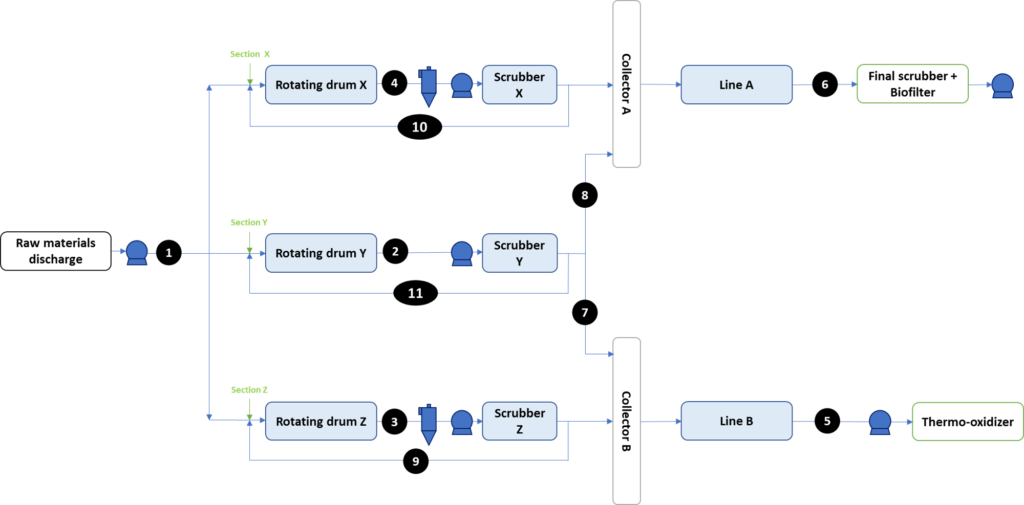
Once the flow lines have been screened, it is then possible to optimise the air extraction system, taking into account the chemical and physical characteristics of the flows and the requirements of the production process, thereby minimising consumption and waste and maximising the efficiency of the available systems.